
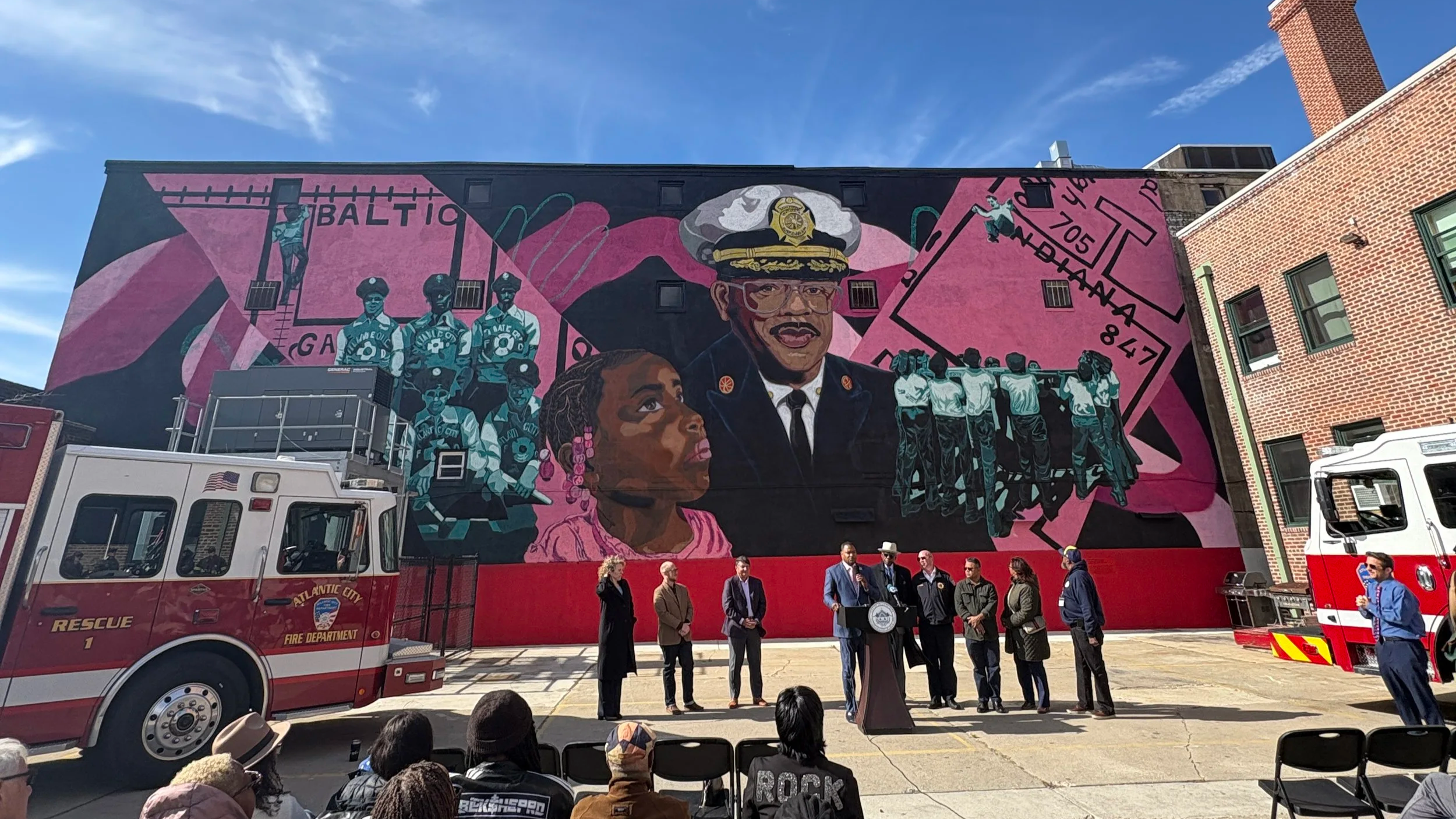
The Door That Opened by Chanelle René, assisted by John Morris.
ACAF Staff Image.
For the better part of the 20th century, every Atlantic City firefighter’s career began at the same place: Fire Station 2 at Indiana and Baltic Avenues to commence training at the fire department’s Drill School. Now, a new mural, The Door That Opened by lead artist Chanelle René, unlocks our history and honors the generations of firefighters who have protected our city and its residents with uncommon valor.
On October 21, 2026 the Atlantic City Arts Foundation co-hosted a mural dedication ceremony with the City of Atlantic City to invite the Atlantic City Fire Department and public to celebrate the addition of this major public artwork to the city’s catalogue. The well-attended dedication ceremony brought together community members, city leaders, and firefighters to celebrate the new artwork and the ongoing preservation of Fire Station 2. To officially welcome the mural to its new home, the Atlantic City Fire Department performed a traditional "wet down" ceremony, using Engine 2 to spray water across the finished piece akin to how the department welcomes new fire engines and douses recruits after completing department training. Read more in the Press of Atlantic City’s article “New mural celebrates Black Atlantic City firefighters” and see the coverage on 6ABC Action News.
The journey to bring The Door That Opened to life began early in 2026, directed by the Atlantic City Arts Foundation in close partnership with the City of Atlantic City and local community leaders and its lead artist. Designed and executed by lead artist Chanelle René, with assistance from artist John Morris, the mural (ACAF’s 107th) stands as a landmark tribute to the legacy of Atlantic City's Fire Station 2 in the historic Northside neighborhood and to the department’s first Black deputy chief, Marvin E. Beatty Jr.
Living History at Fire Station 2
Located within the Northside Institutional Historic District, Fire Station 2 holds a profound place in local history as one of the first firehouses in the city to be racially integrated. Due to its centralized position in Atlantic City since its construction in 1920, Fire Station 2 was long home to specialized equipment required for a fire department to professionally serve the many types of emergencies faced within an urban coastal community, specifically rescuing people from great heights or swift waters. As such, the station also housed the Fire Station 2 Drill School, where generations of firefighters trained and graduated. It was through the Drill School that Black and white firefighters were trained side by side before gaining assignment in a city and department that was still segregated before 1960s Civil Rights reforms. It is due to this history that the fire station was awarded an African American Civil Rights Grant along with other Historic Preservation grants to preserve and enhance the building interior and exterior, a project that is on-going, but ensures this historic site is preserved and remains operational.
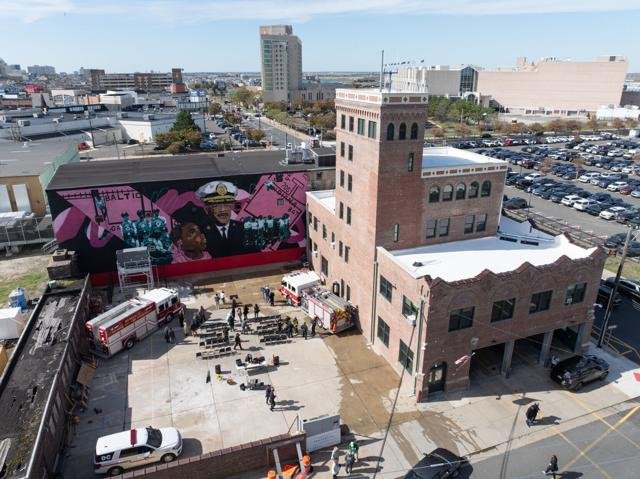
Aerial view of The Door That Opened at Indiana Avenue Firehouse.
Image courtesy of The Press of Atlantic City, Matthew Strabuk Staff Photographer.
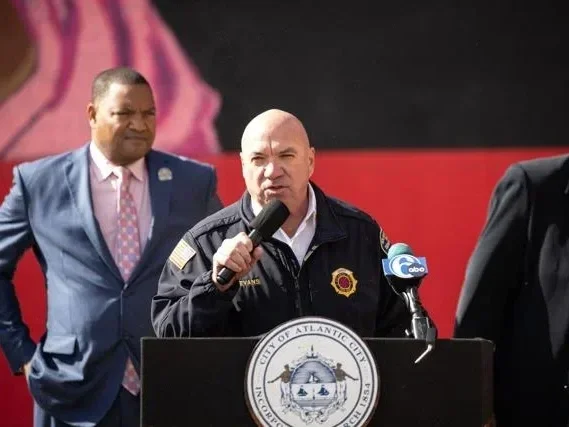
Atlantic City Fire Chief Scott Evans.
Image courtesy of The Press of Atlantic City, Matthew Strabuk Staff Photographer.
“This building has a lot of history and is extremely significant to the fire service,” said Atlantic City Fire Chief Scott Evans, in a press release from 2025 recognizing the selection of Fire Station 2 for historic preservation funding. “The building currently houses the Water Rescue Unit, Special Operations Unit and the Training Division, along with Engine 2 and Rescue 1. I’m excited to work on the rehabilitation and waterproofing of this station.”
Through a series of listening sessions held between fire department chiefs and deputies hosted by the Atlantic City Arts Foundation, our local firefighters were keen to stress the importance of the fire department growing alongside and reflecting the city’s history and growth. At every major turning point from the arrival of trains then later automobiles, to mid-century efforts to recognize civil rights, to the legalization of gambling; the Atlantic City Fire Department has grown alongside the city as one of its oldest and respected civic institutions. Today’s firefighters stressed that once a recruit becomes an Atlantic City Firefighter, they are accepted into a fellowship that supersedes social, economic, or racial identities.
Central Figures and Community Representation
The artwork captures this rich timeline, drawing from archival images of training exercises conducted at Fire Station 2, alongside portrayals of Black and white firefighters working side by side to embody the mutual trust and inclusion defining the brotherhood of service. Training exercises drawn directly from archival photographs include the ladder climbs and life net catches conducted at Fire Station 2 in standard drill training.
At the heart of the composition is a striking portrait of the late Fire Chief and Drill Commander Marvin E. Beatty Jr. Beatty was one of the rookie firefighters who, along with John Jasper and Pierre Hollingsworth, would become known as “The Big Three,” for integrating the Atlantic City Fire Department in 1956. Prior to de-segregation, African-American firefighters were only assigned to the fire station at Indiana and Grant Avenues. Today, Fire Station 2 at Indiana and Baltic is officially named the Marvin E. Beatty, Jr. Memorial Fire Station in honor of his trailblazing in the Atlantic City Fire Department.
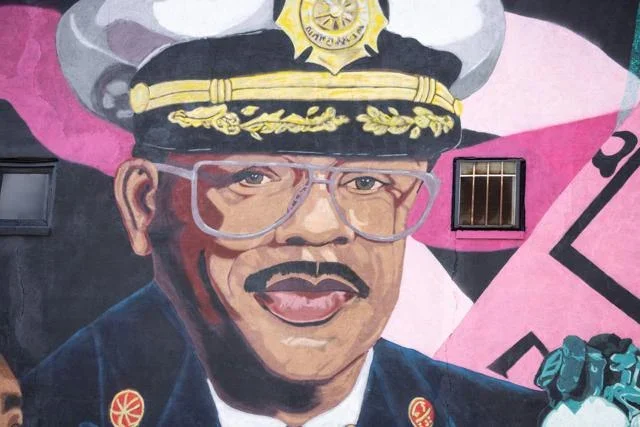
Detail of Fire Chief and Drill Commander Marvin E. Beatty Jr.
Image courtesy of The Press of Atlantic City, Matthew Strabuk Staff Photographer.
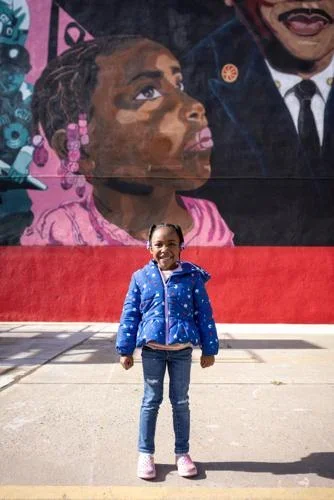
4-year-old Quinn Morris standing with her likeness in The Door That Opened.
Image courtesy of The Press of Atlantic City, Matthew Strabuk Staff Photographer.
Standing beside Beatty in the mural is a young girl looking up in admiration—modeled by Quinn Morris, daughter of assisting artist John Morris. This central imagery symbolizes the generational impact of Black representation within the Atlantic City Fire Department and the inspiring role models created for future generations in the Northside community.
Chanelle René's distinctive style merges abstract realism with vibrant, jewel-toned color and layered mark-making. Painted across an expansive wall measuring approximately 40 by 90 feet, the muralists utilized spray paint to achieve dynamic textures and movement while intentionally preserving dark, rich backgrounds. Anchoring the entire composition along its base is a bold red line, symbolizing the sacrifices and steadfast dedication of firefighters in service to their community. Atlantic City Fire Department additionally stressed the importance of sacrifice and duty among firefighters, requesting specifically to honor the memory of firefighters Albert Mallen #705 and Captain Robert McCarty #847 whose badge numbers are included in the mural.
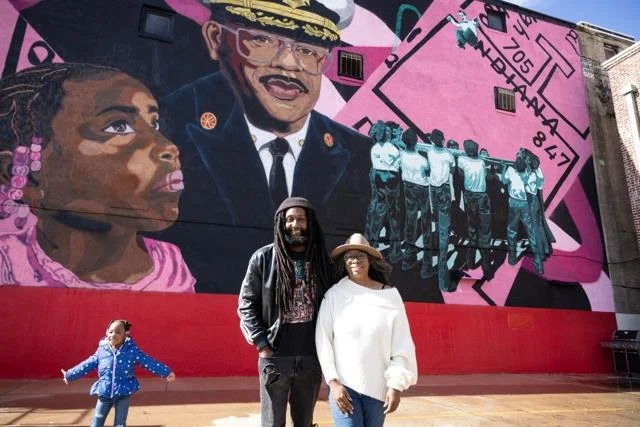
Lead artist Chanelle René (R) with assisting artist John Morris (L).
Image courtesy of The Press of Atlantic City, Matthew Strabuk Staff Photographer.
“This mural symbolizes belonging, community, and bravery,” shared muralist Chanelle René. “It's a portrait of what Black representation in the fire department and Atlantic City’s Northside means across generations. But ultimately, this mural belongs to the community. The people passing by who see themselves in some way and realize what’s possible. That’s the power of The Door That Opened and public art.”
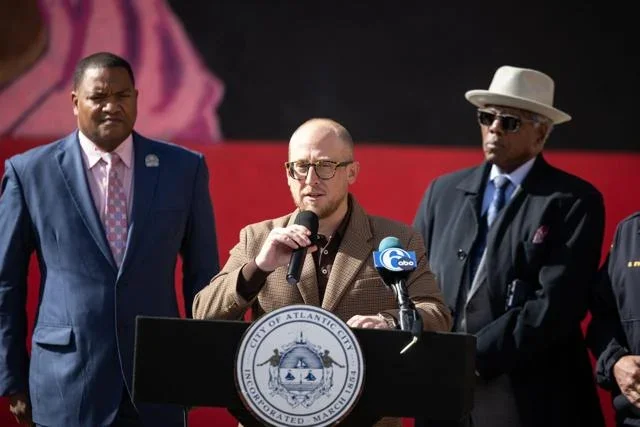
Atlantic City Arts Foundation’s executive director, Michael Atkins.
Image courtesy of The Press of Atlantic City, Matthew Strabuk Staff Photographer.
"This mural stands as a powerful tribute to our brave firefighters and public servants who risk everything for Atlantic City," said Michael Atkins, Executive Director of the Atlantic City Arts Foundation. "The Door That Opened honors the extraordinary legacy of leadership and service in our fire department, showing how public art can celebrate our heroes and common history, ignite community pride, and inspire future generations. We are deeply grateful to artist Chanelle René, assisting artist John Morris, and our funding partners for bringing this vital history to life in our 107th mural in the city."


Completed in September 2026, the mural was made possible through extensive support from multiple funding partners, including the City of Atlantic City / Community Development Block Grant (CDBG), the Casino Reinvestment Development Authority (CRDA), and Midtown CDC. The New Jersey Economic Development Authority (NJEDA) through A.R.T. Phase 1 to refurbish, reinstall, and administer new mural projects.
