
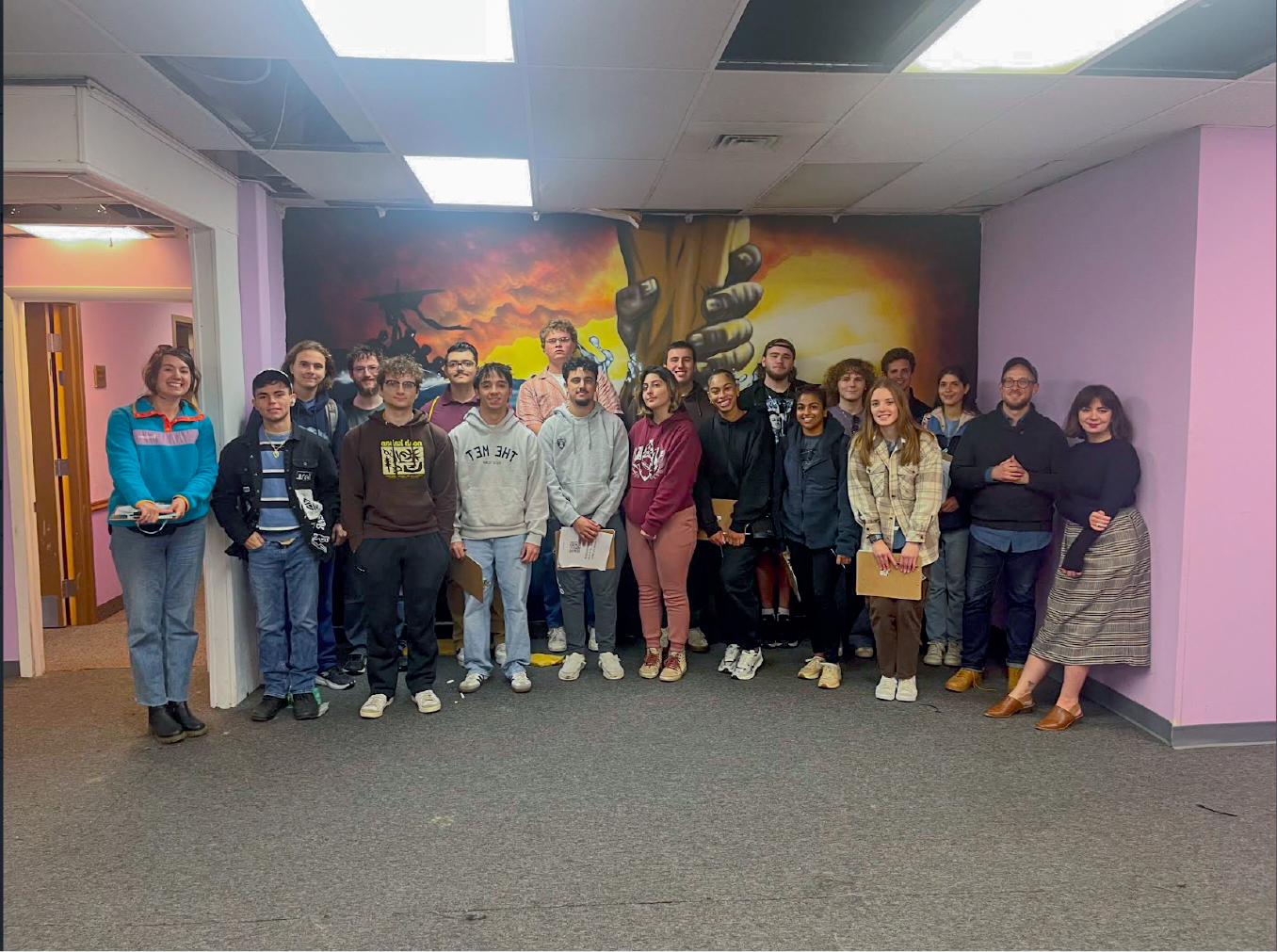
Professor Bucknum’s class visiting 2601 Pacific Avenue with the Atlantic City Arts Foundation Team.
My first experience with Atlantic City was by way of the city’s reputation and not its physical space. While waiting for a table on a family vacation in Ocean City sometime in the 1990s, my (likely) four year old brother passed the time as a child of the ‘90s would; pulling all the knobs on the cigarette vending machine located at the front of the restaurant. One lucky knob somehow released all the quarters that were stored within the machine and we quickly scooped up as much of this jackpot as we could carry. When our waitress spotted the small treasure of quarters, she asked if we had just come from Atlantic City and the adults at the table laughed. My elementary school self had no idea what this all meant and whispered to my parents, “what’s Atlantic City?”
Until recently, this question remained unanswered aside from tangential assessments of the city’s physical space gleaned from Brigantine Beach, car interiors, and a presentation at the NJ Planning and Redevelopment Conference this past summer by Michael Atkins. After hearing about the Atlantic City Arts Foundation’s ARTeriors program, I began musing about how this community engagement program could provide an embodied experience for students enrolled in Urban Geography at Rowan University and for myself.
My Urban Geography course is anchored in observational research methods—a tool used by planners to understand how a public space is being used by the public—to understand cities as habitat for homo sapiens. This technique is utilized by planners to systematically assess how a space functions through observing the interaction of people within the space. As part of the Fall 2025 semester, students are observing the ARTeriors site before the pop-up gallery installation and after to understand the effect this design activation has on the immediate environment. At the same time students are learning about field work, collaboration, and Atlantic City.
As a planner who believes strongly in the power of the arts as placemaking and economic development, I look forward to answering my initial “what’s Atlantic City” question through embodied experiences with its space, people, and possibly quarters.
Additional Reading:
Urban designer Jan Gehl and urbanist William Whyte notably contribute a methodological framework to this technique within How to Study Public Life (Gehl, J., & Svarre, B., 2013) and The Social Life of Small Urban Spaces (Whyte, 1980) that introduces ways of measuring and documenting public use of public spaces.
Megan Bucknum, PHD is an Associate Teaching Professor in the Department of Geography, Planning & Sustainability at Rowan University.
Originally published November 2025, Issue No. 1, The Arts Dispatch.